Choosing an ERP system is an important decision for every SME organization. You are not just selecting software, but also a new way of working. Processes change, systems are integrated, and employees will collaborate differently.
A good ERP system helps you automate and connect business processes. Think of CRM, accounting, inventory management, and projects. The result: more clarity, less manual work, and better decisions.
But which ERP system is the best fit for your organization?
In the Netherlands, many companies turn to solutions like Visma Net ERP and Odoo. Both systems are popular within SMEs, but they differ significantly in approach, flexibility, and scope. In this blog, we outline the key differences and similarities for you.
What is Visma?
Visma Net ERP is a cloud-based ERP system with a strong focus on financial processes. The system is widely used by medium-sized organizations, particularly in the Netherlands and Scandinavia.
The strength of Visma lies in finance: accounting, reporting, and compliance form the core of the platform. Surrounding this, the system offers modules for logistics, projects, and purchasing/sales.
Strong points of Visma Net ERP are:
- Strong financial functionality (general ledger, VAT, audit trail)
- Good support for compliance and legislation
- Cloud-first solution with stable updates
- Suitable for organizations focused on control and standardization
Visma Net is particularly interesting for organizations where finance plays a central role.
What is Odoo?
Odoo is an international ERP platform that stands out for its all-in-one approach. Instead of separate systems for CRM, accounting, inventory, projects, and e-commerce, Odoo brings everything together in one environment.
The platform is modular in structure. This means you can start small and easily expand as your organization grows.
Strong points of Odoo are:
- Fully integrated business software
- Modular and scalable
- Very user-friendly
- Many integration possibilities
- Suitable for growing and changing organizations
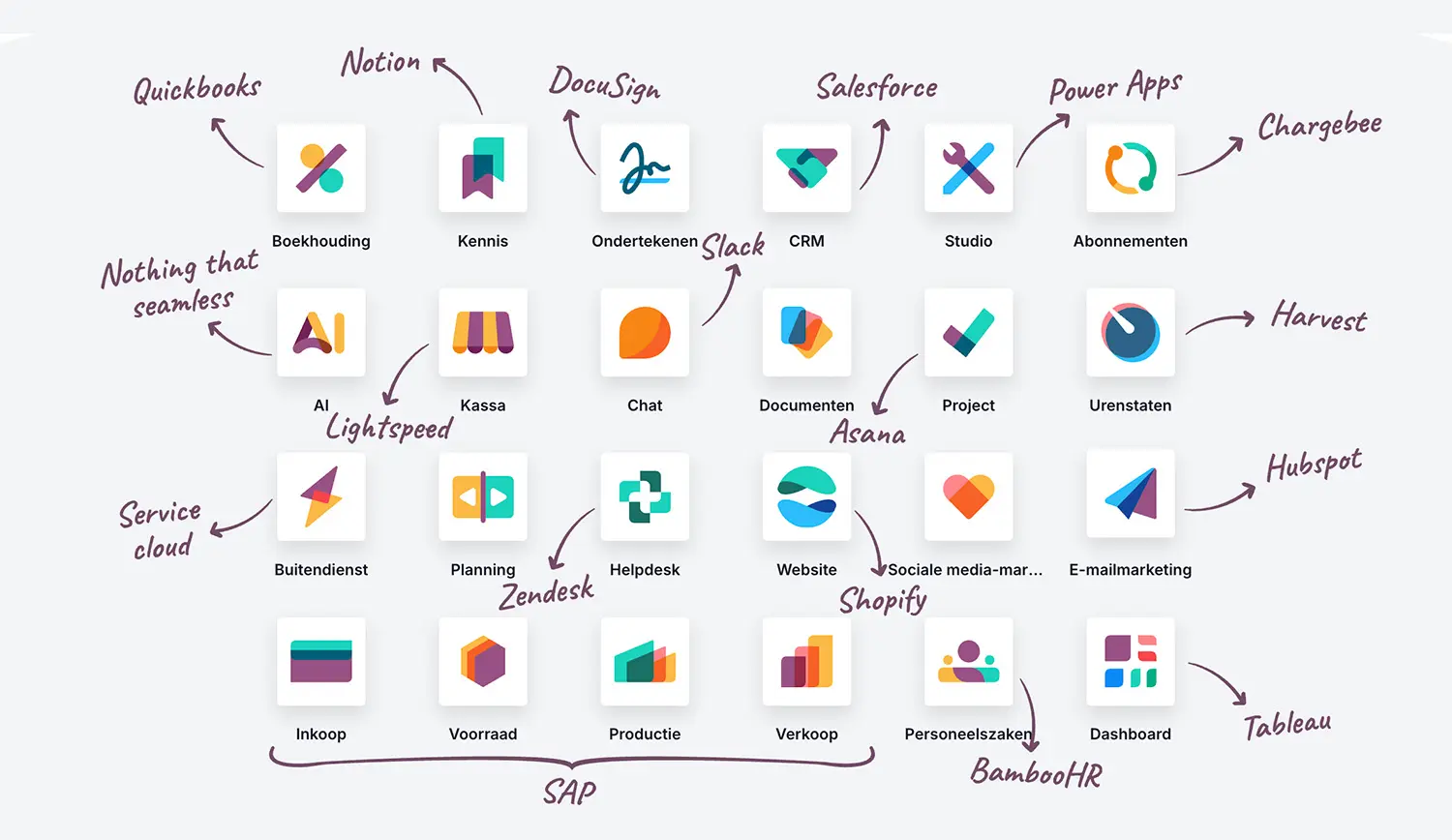
With millions of users worldwide, Odoo has grown to become one of the largest ERP platforms on the market.
The main differences between Visma Net ERP and Odoo
Although both systems are suitable for SMEs, the biggest difference lies in philosophy and flexibility.
1. Finance-first vs. all-in-one platform
Visma Net ERP is built from finance. This means that financial processes are leading and other modules connect to them.
Odoo has been specifically developed as a fully integrated platform, where all processes (from marketing and sales to invoicing and inventory) are interconnected.
Conclusion: Are you looking for strong financial control? Then Visma is a better fit. Do you want one system for all your processes? Then Odoo has a clear advantage.
2. Flexibility and customization
Odoo is (partially) open source and therefore very flexible. Processes can be relatively easily adapted to your organization.
Visma Net is more standardized. This provides stability and predictability, but limits the possibilities for customization.
Conclusion: Odoo offers more flexibility, Visma more structure.
3. Usability
Odoo is known for its modern and intuitive interface. New users can often get started quickly.
Visma Net is clear for financial users, but it can be less intuitive for other departments such as sales or operations.
Conclusion: For widespread adoption within the organization, Odoo often scores higher.
4. Integrations
Visma Net works extensively with integrations through APIs and partner solutions. This allows you to build a best-of-breed landscape.
Odoo aims to keep as much functionality as possible within one platform, which reduces the need for integrations.
Conclusion: Visma = more integrations, Odoo = more all-in-one
5. Costs and Pricing Model
Visma Net works with licenses and modules, often in combination with implementation partners. The costs depend on your setup and can increase with expansion.
Odoo operates on a per-user pricing model, giving you access to multiple apps. This makes the model more transparent and often more scalable for growth.
Conclusion: Odoo is often more predictable in costs, while Visma can become more expensive when expanding.
Comparison: Odoo vs. Visma
Characteristic | Odoo | Visma Net ERP |
All-in-one platform | ✅ (fully integrated) | ⚠️ (focus on finance) |
CRM integrated | ✅ (full-fledged) | ⚠️ (limited) |
Inventory & logistics | ✅ (extensive) | ✅ (strong foundation) |
Project management | ✅ | ✅ |
E-commerce | ✅ | ❌ |
Flexibility / customization | ✅ | ❌ |
Open API & integrations | ✅ | ✅ |
Usability | ✅ | ⚠️ |
Finance & compliance | ⚠️ | ✅ |
One central data source | ✅ | ⚠️ |
Price structure | Pay per user | Module/license based |
When do you choose Visma?
Visma is a good choice if:
- Finance and compliance are central
- Your organization needs standardization
- You need little customization
- You work with clear, stable processes
- Control and auditability are important
For organizations with a strong financial focus, Visma is often a logical and safe choice.
When do you choose Odoo?
Odoo is often more interesting when:
- You want to replace multiple systems with one platform
- You want to integrate your processes across departments
- Your organization is growing and needs flexibility
- You have a need for customization and scalability
- You also want to integrate CRM, e-commerce, or projects
For many SMEs, it is precisely that integration and flexibility that is the decisive factor.
The role of an implementation partner
Whatever choice you make: the implementation is at least as important as the software itself.
Implementing an ERP system impacts your entire organization. Think about:
- Process changes
- Data migration
- Employee training
- Acceptance within teams
A good implementation partner helps you approach this process in a structured and successful manner. This way, you avoid mistakes and get more value from your investment.
Conclusion: which choice fits your organization?
Both Visma and Odoo are strong ERP systems for SMEs. The right choice depends on your organization, processes, and ambitions.
Are you mainly looking for a stable system with strong financial control and little complexity? Then Visma Net is a logical choice.
Do you want a single flexible and integrated platform that grows with your organization and brings together multiple processes? Then Odoo offers many more possibilities.
In practice, we see that more and more SMEs are opting for flexibility, scalability, and integration. That's exactly where Odoo makes a difference.
Curious about what fits best with your organization?
Are you unsure between Visma Net ERP and Odoo? Or do you want to know what your processes could look like in one integrated system? As a Odoo partner we are happy to think along with you.