
Choosing an ERP system is an important decision for every SME organization. You are not just choosing software, but also a new way of working. Processes are being restructured, data becomes centrally available, and departments will collaborate more intensively.
A good ERP system helps organizations work more efficiently and gain better control over processes such as CRM, finance, inventory management, production, projects, and e-commerce.
Two well-known ERP solutions within SMEs are SAP Business One and Odoo. Both systems offer a lot of functionality but differ significantly in flexibility, user-friendliness, and cost structure. In this blog, we compare both systems and outline the main differences.
What is SAP Business One?
SAP Business One is SAP's ERP solution for small and medium-sized enterprises. The system primarily targets organizations with complex financial, logistical, or production processes.
SAP Business One offers functionalities for:
Finance
CRM
Purchasing
Inventory management
Production
Reporting
Strengths of SAP Business One:
Extensive financial functionalities
Suitable for logistics and production
Scalable for larger organizations
Strong international reputation
SAP Business One is often chosen by organizations that need a traditional ERP platform with extensive process support.
What is Odoo?
Odoo is an international ERP platform that stands out for its all-in-one approach. Instead of separate systems for CRM, finance, inventory, projects, and e-commerce, Odoo brings everything together in one integrated platform.
The system is modular. This allows companies to start small and easily expand later with additional functionalities.
Strong points of Odoo are:
Fully integrated business software
Modern and user-friendly interface
Flexible and scalable
Advanced MRP/Manufacturing
Strong e-commerce and website functionalities
Many integration possibilities
With over 12 million users worldwide, Odoo has become one of the fastest-growing ERP platforms in the world.
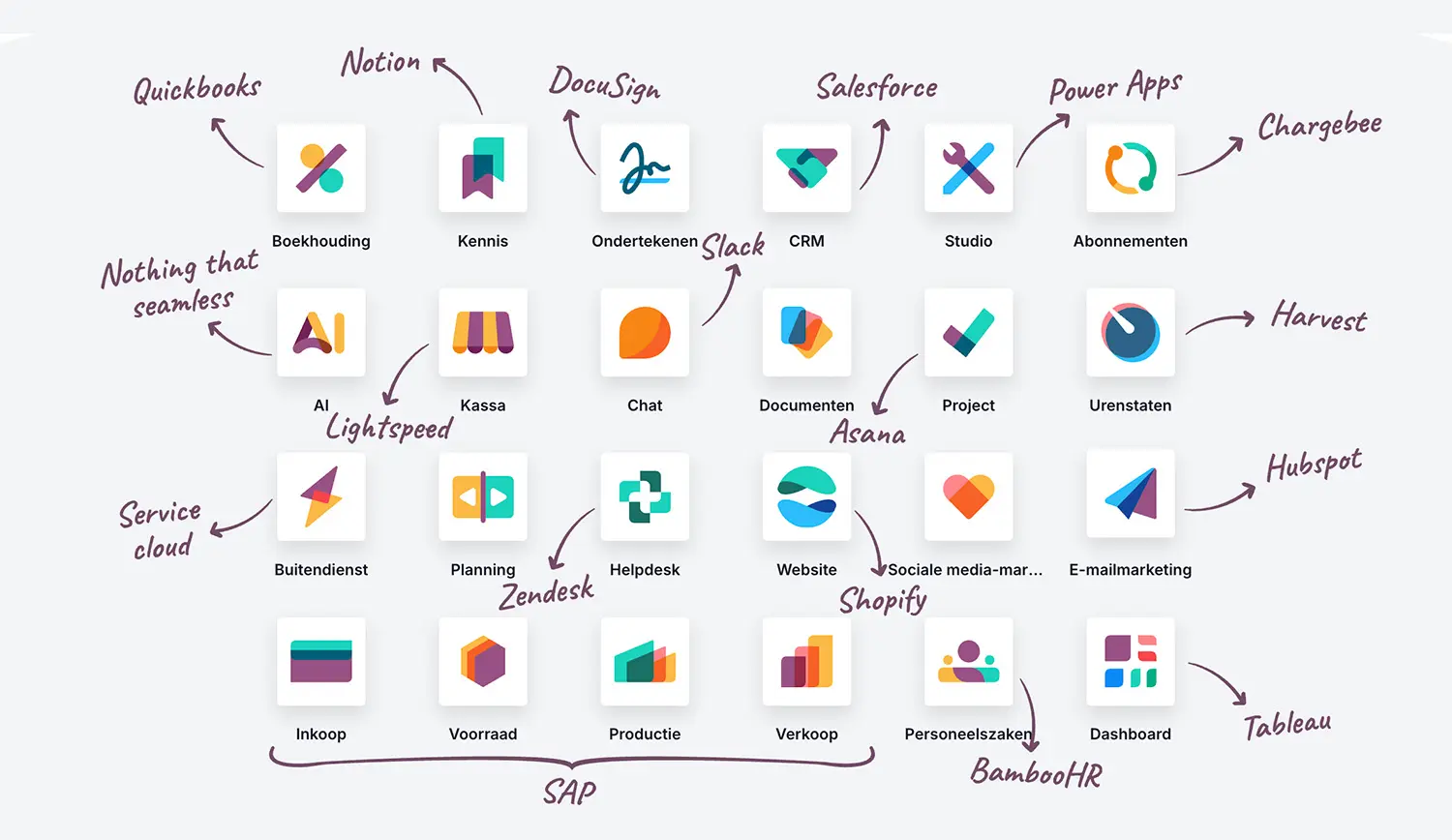
The main differences between SAP Business One and Odoo
1. All-in-one platform vs. traditional ERP
SAP Business One is a classic ERP system with a strong focus on finance, logistics, and manufacturing.
Odoo is developed as a fully integrated platform where ERP, CRM, webshop, marketing, and operations work together from one central database. This often means fewer separate systems and connections are needed.
3. Usability
Odoo is known for its modern and intuitive interface. Users can typically work with the system quickly without extensive training.
SAP Business One offers a lot of functionality but is often perceived as more traditional and complex. This can particularly impact adoption within teams outside of finance and operations.
2. Flexibility and customization
Odoo is (partially) open source and therefore very flexible. Processes can be relatively easily adapted to your organization.
SAP Business One also offers customization, but adjustments are often more complex and costly.
For organizations that value flexibility, Odoo generally offers more freedom.
4. E-commerce and website functionality
An important difference is that Odoo comes standard with integrated e-commerce and website functionalities, such as:
webshopbeheer
klantportalen
marketing automation
SEO functionalities
e-mailmarketing
For SAP Business One, external solutions are often used for this.
For organizations that want to combine online sales and ERP within one system, Odoo offers clear advantages.
5. Costs and implementation
Both systems also differ significantly in terms of cost structure.
SAP Business One is known as a powerful but relatively expensive ERP platform. Implementations are often larger and more time-consuming.
Odoo works with a more transparent pricing model per user and provides access to many integrated apps within the same platform. As a result, the total investment for many SMEs is lower.
Comparison: Odoo vs. SAP Business One
Characteristic | Odoo | SAP Business One |
All-in-one platform | ✅ | ⚠️ |
CRM integrated | ✅ | ✅ |
Inventory & production | ✅ | ✅ |
E-commerce & website | ✅ | ❌ |
Usability | ✅ | ⚠️ |
Flexibility / customization | ✅ | ⚠️ |
Open API & integrations | ✅ | ✅ |
One central data source | ✅ | ⚠️ |
Implementation speed | ✅ | ⚠️ |
Cost structure | Transparent | Relatively high |
Architecture | ✅ Cloud-native (Browser-first) | ⚠️ Desktop-based (Cloud possible) |
Mobile app | ✅ Full functionality | ⚠️ Limited apps per module |
For a comprehensive feature comparison, you can also check the official overview from Odoo:https://www.odoo.com/nl_NL/page/odoo-vs-SAP-business-one
When do you choose SAP Business One?
SAP Business One is often a good choice if:
Finance and logistics are central
Production processes are important
You operate internationally
You need a traditional ERP platform.
SAP offers a stable and comprehensive solution, but it often brings more complexity as well.
When do you choose Odoo?
Odoo is often more interesting when:
You want to replace multiple systems with one platform
You want to integrate your processes end-to-end.
Flexibility is important.
You also want to combine CRM, webshop, and marketing.
You want to keep control over implementation and licensing costs.
For many SMEs, Odoo offers a strong combination of functionality, ease of use, and scalability.
The role of an implementation partner
The choice of ERP software is important, but the implementation ultimately determines the success of the project.
An ERP implementation almost always affects multiple departments and processes, such as data migration, process optimization, user adoption, and integrations.
An experienced implementation partner helps to make this transition manageable and successful.
At Kilurion, we believe in a pragmatic approach: no unnecessary complexity, but software that aligns with the way your organization works.
Conclusion: which choice fits your organization?
Both SAP Business One and Odoo are powerful ERP systems for SMEs. Which solution fits best depends on your organization, processes, and growth plans.
Are you looking for a traditional ERP platform with strong financial and logistical functionalities? Then SAP Business One may be a good choice.
However, if you want one flexible and fully integrated platform that brings together CRM, ERP, e-commerce, inventory, and projects, then Odoo offers more possibilities for many SMEs. At Kilurion, we see in practice that it is precisely that flexibility and integration that make the difference.
Curious about which ERP system best fits your organization?
Are you unsure between SAP Business One and Odoo? Or do you want to know what your processes could look like within one integrated platform? As an Odoo partner, we are happy to think along with you.