Choosing an ERP system is a strategic decision for every SME. It's not just about software, but about how you organize processes, collaborate, and grow as a company.
A good ERP system connects all important business processes. From CRM and finance to inventory, projects, and production. It provides more clarity, less manual work, and better decisions.
Two well-known players in this market are Microsoft Dynamics 365 and Odoo. Both systems offer extensive functionalities, but differ significantly in approach, flexibility, and cost.
In this blog, we compare both systems so that you can make an informed choice.
What is Microsoft Dynamics 365?
Microsoft Dynamics 365 is a comprehensive suite of business applications that combines CRM and ERP. The platform consists of several standalone applications, such as Business Central (ERP), Sales, Customer Service, and Marketing.
Dynamics 365 is part of the Microsoft ecosystem and integrates seamlessly with tools like Outlook, Teams, and Power BI.
Strengths of Microsoft Dynamics 365:
- Powerful analytics and reporting (Power BI)
- Strong integration with Microsoft products
- Suitable for complex and international organizations
- Enterprise-level scalability
Dynamics 365 is often used by larger organizations or companies with complex processes.
What is Odoo?
Odoo is an international ERP platform that stands out for its all-in-one approach. Instead of separate systems for CRM, accounting, inventory, projects, and e-commerce, Odoo brings everything together in one environment.
The platform is modular in structure. This means you can start small and easily expand with additional functionalities later on.
Strong points of Odoo are:
- Fully integrated business software
- Modular and scalable
- Very user-friendly
- Many integration possibilities
- Suitable for growing organizations
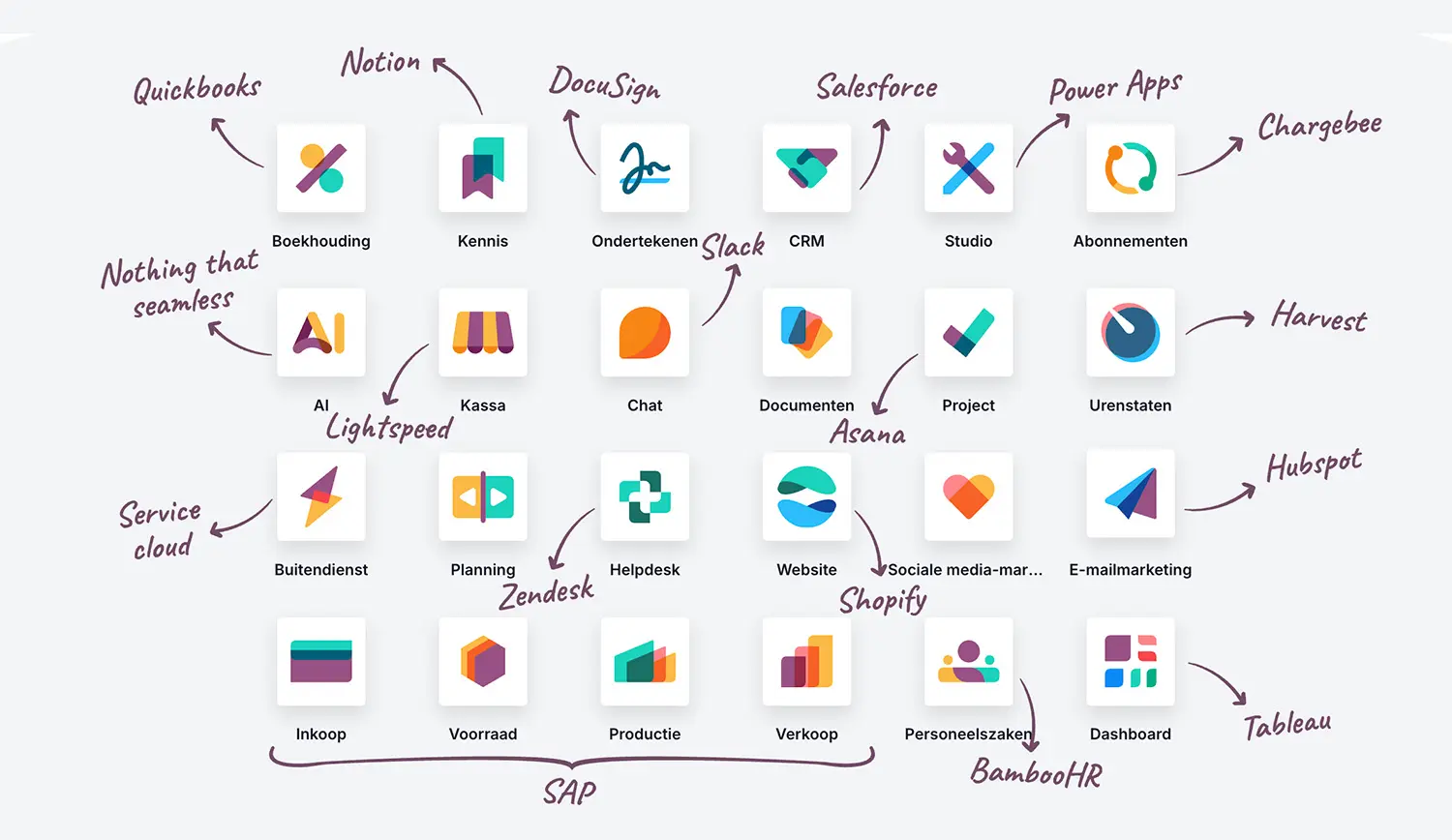
With more than 12 million users worldwide, Odoo has now grown into one of the largest ERP platforms in the world. The headquarters is located in Belgium.
The main differences between Microsoft Dynamics 365 and Odoo
Although both systems offer a lot of functionality, the biggest difference lies in philosophy.
1. Platform vs. standalone applications
Microsoft Dynamics 365 consists of multiple applications that you can purchase and connect separately. This makes it powerful, but also complex and often more expensive.
Odoo offers a single integrated platform where all modules work together by default. This ensures simplicity, fewer integrations, and one central data source.
2. Flexibility and customization
Odoo is (partially) open source and therefore very flexible. You can fully customize processes to fit your organization.
Dynamics 365 also offers customization through the Microsoft Power Platform, but it is more closed. Deeper customizations are more complex and often more expensive.
3. Usability
Odoo is known for its modern and intuitive interface. Users can quickly get started without extensive training.
Dynamics 365 is powerful, but it can be complex and less user-friendly, especially for non-technical users.
4. Integrations
Dynamics 365 stands out within the Microsoft ecosystem.
Odoo offers extensive integrations with both international tools and e-commerce platforms, logistics providers, and payment providers.
5. Costs and Licensing Model
Dynamics 365 operates with multiple licenses per module. Think of separate costs for finance, sales, marketing, and HR. As a result, costs can add up quickly.
Odoo operates with a single price per user, giving you access to all apps. This makes the model more transparent and often more cost-effective.
Comparison: Odoo vs. Microsoft Dynamics 365
Characteristic | Odoo | Microsoft Dynamics 365 |
All-in-one platform | ✅ (fully integrated) | ⚠️ (loose apps) |
CRM integrated | ✅ | ✅ |
Inventory & production | ✅ (extensive) | ✅ (very extensive) |
E-commerce & website | ✅ | ❌ (via external tools) |
Flexibility / customization | ✅ (very high) | ⚠️ (limited) |
Open API & integrations | ✅ | ⚠️ (mainly Microsoft) |
Usability | ✅ | ⚠️ |
Analytics / BI | ⚠️ | ✅ (very strong) |
One central data source | ✅ | ⚠️ |
Price structure | Pay per user | Quickly expensive with growth |
When do you choose Microsoft Dynamics 365?
Dynamics 365 is a good choice if:
- Your organization is complex and international
- You are already fully working in the Microsoft ecosystem
- You need advanced analytics and BI
- Budget is less of a limiting factor
It is a powerful platform, but often more than necessary for the average SME.
When do you choose Odoo?
Odoo is often the better choice when:
- You want to replace multiple systems with one platform
- You find flexibility and scalability important
- You want to integrate your end-to-end processes
- You want to implement and grow quickly
- You want to keep your costs manageable
For many SMEs, Odoo offers the perfect balance between functionality, ease of use, and price.
The role of an implementation partner
The choice of an ERP system is one thing. The implementation of Microsoft Dynamics 365 or Odoo is at least as important. Our approach focuses on:
- Understanding your processes
- A smart, phased implementation
- User guidance
- Further development after going live
As an Odoo partner, we strongly believe in a pragmatic approach: no unnecessary complexity, but software that works for your organization.
Conclusion: which choice fits your organization?
Both Microsoft Dynamics 365 and Odoo are powerful ERP systems. The right choice depends on your organization, ambitions, and complexity.
Are you looking for an enterprise solution with deep integration within Microsoft? Then Dynamics 365 is a logical choice.
Do you want a flexible, user-friendly, and fully integrated system that grows with your organization? Then Odoo offers more advantages for many SMEs.
At Kilurion, we see in practice that it is precisely that simplicity and flexibility that make the difference.