Choosing an ERP system is an important decision for every SME organization. You are not just selecting software, but also a new way of working. Processes are organized differently, systems are integrated, and employees will collaborate in a different manner.
A good ERP system helps you automate and connect business processes. Think of CRM, accounting, inventory management, HR, and projects. The result: more clarity, less manual work, and better decisions.
But which ERP system is the best fit for your organization? In the Netherlands, many companies turn to two well-known names: AFAS and Odoo. Both systems are popular within the SME sector, but they differ significantly in approach and capabilities.
In this blog, we outline the key differences and similarities for you.
What is AFAS?
AFAS is a Dutch ERP solution with a strong focus on finance and HRM. The system has been a well-established name for many years and is used by organizations that want to manage their administration, payroll processing, and personnel matters effectively. Additionally, it also offers modules for project management, CRM, and logistics. A
Strong points of AFAS are:
- Comprehensive HRM and payroll functionalities
- Good alignment with Dutch laws and regulations
- Reliable support and service
- Everything in one cloud environment
AFAS is particularly interesting for organizations where finance and HR are central.
What is Odoo?
Odoo is an international ERP platform that stands out for its all-in-one approach. Instead of separate systems for CRM, accounting, inventory, projects, and e-commerce, Odoo brings everything together in one environment.
The platform is modular in structure. This means you can start small and easily expand with additional functionalities later on.
Strong points of Odoo are:
- Fully integrated business software
- Modular and scalable
- Very user-friendly
- Many integration possibilities
- Suitable for growing organizations
With Odoo, you replace twenty existing apps at once, such as Salesforce, Asana, and Shopify. In the overview below, you can see all 24 apps from Odoo.
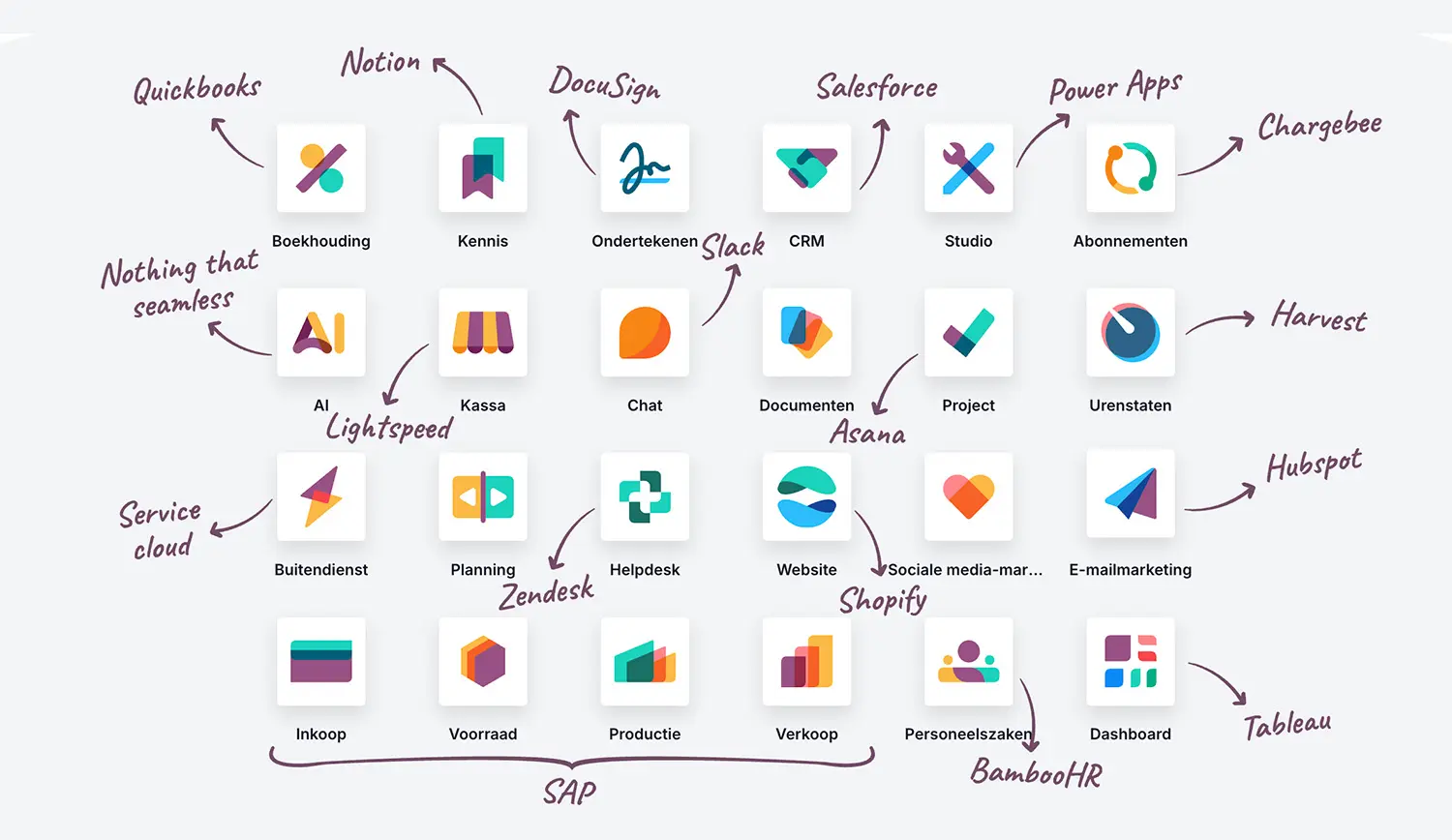
With more than 12 million users worldwide, Odoo has now grown into one of the largest ERP platforms in the world. The headquarters is located in Belgium.
The main differences between AFAS and Odoo
Although both systems are suitable for SMEs, the biggest difference lies in flexibility and scope.
1. All-in-one vs. focus on core processes
AFAS offers multiple modules, such as CRM, projects, and logistics. In practice, however, we often see that these are less deeply integrated or limited in functionality, causing organizations to still work with additional tools.
Odoo is designed from the ground up as a fully integrated platform, where all processes (from marketing and sales to inventory and invoicing) seamlessly connect with each other. This provides a single central data source and a complete 360-degree overview.
2. Flexibility and customization
Odoo is (partially) open source and therefore very flexible. Processes can be relatively easily adapted to the organization.
AFAS is more closed. This provides stability, but limits customization and adjustments.
3. Usability
Odoo has a modern and intuitive interface, making the system accessible to a wide range of users.
AFAS is often perceived as less user-friendly outside the finance department.
4. Integrations
Odoo offers extensive integration possibilities, including internationally (for example, with e-commerce platforms like Amazon and Bol.com).
AFAS primarily focuses on the Dutch market and integrates well with local tools and legislation.
5. Payroll Processing
Here AFAS has an advantage: payroll is fully integrated.
Odoo has a solid payroll app, but the legislation for the Netherlands is (not yet) natively supported.
Comparison: Odoo vs. AFAS
Characteristic | Odoo | AFAS |
All-in-one platform | ✅ (fully integrated) | ⚠️ (modules available) |
CRM integrated | ✅ (full-fledged) | ⚠️ (basic functionality) |
Inventory & logistics | ✅ (advanced) | ⚠️ (present, but more limited) |
Project management | ✅ (extensive) | ⚠️ (present) |
E-commerce & webshop | ✅ | ❌ |
Flexibility / customization | ✅ | ❌ |
Open API & integrations | ✅ | ⚠️ |
Usability | ✅ | ⚠️ |
Payroll processing/Dutch legislation | ⚠️ (to be updated manually) | ✅ |
Scalability | ✅ | ⚠️ |
One central data source | ✅ | ❌ |
Price structure | Pay per user | Quickly expensive with growth |
When do you choose AFAS?
AFAS is a good choice if:
- Your organization heavily relies on HR and payroll
- You have little need for integrations
- You work within the Dutch market and legislation
AFAS offers more than just administration, but it works best in organizations where these core processes are central.
When do you choose Odoo?
Odoo is often more interesting when:
- You want to replace multiple systems and software with one platform
- You want to optimize your processes across departments
- Your organization is growing and flexibility is important
- You need custom solutions and integrations
- You also want to integrate processes such as sales, inventory, projects, or e-commerce
For many SMEs, that integration is the decisive factor.
The role of an implementation partner
Whatever choice you make: the implementation is at least as important as the software itself. Implementing an ERP system impacts your entire organization. Consider process changes, data migration, employee training, and acceptance within teams.
An implementation partner helps you approach this process in a structured and successful manner. Through experience, best practices, and guidance, you avoid mistakes and get more value from your investment.
Conclusion: which choice fits your organization?
Both AFAS and Odoo are strong ERP systems for SMEs. The best choice depends on your organization, processes, and ambitions. Are you mainly looking for a solution for finance and HR? Then AFAS is a logical choice.
However, do you want one integrated system that grows with you and brings together multiple business processes? Then Odoo offers many more possibilities.
At Kilurion, we see in practice that more and more companies are opting for flexibility, scalability, and integration. That's exactly where Odoo makes a difference.